
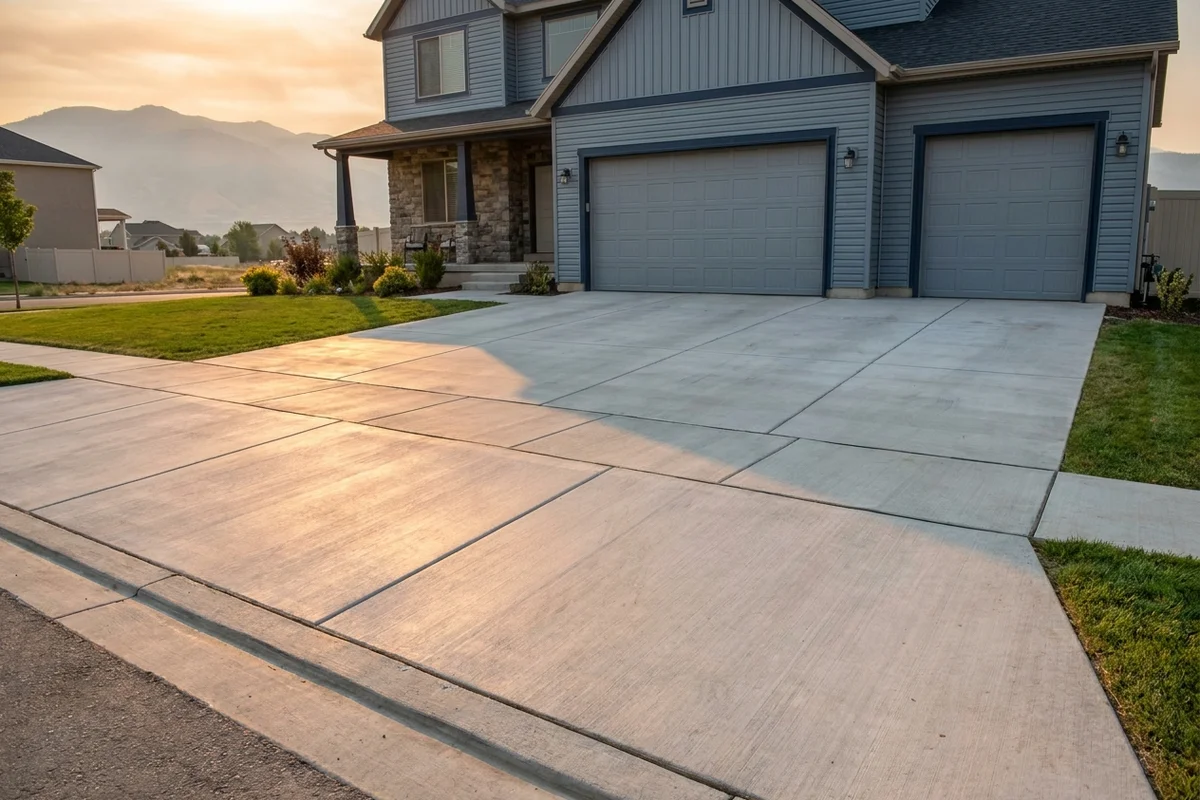
Concrete Driveways
Tear-out, replacement, and new pours from a Utah-licensed crew. Free on-site estimate, no high-pressure pitch — built to last 30+ years through Wasatch Front freeze-thaw.
Now booking April–October 2026 driveway pours along the Wasatch Front
Now booking April–October 2026 driveway pours along the Wasatch Front
Most cracked driveways on the Wasatch Front weren't poured wrong on day one — they were poured for a different climate. Utah hands a slab three problems most concrete crews underbuild for: 100°F summer-to-winter temperature swings, expansive clay subgrades that heave with moisture, and aggressive deicing salts that chemically attack the surface.
BaseScape pours residential driveways built for that combination, not against it. Our standard spec on every driveway:
- 4-inch minimum slab thickness (5″ where the spec calls for it — RV pads, heavy trucks, steep approaches)
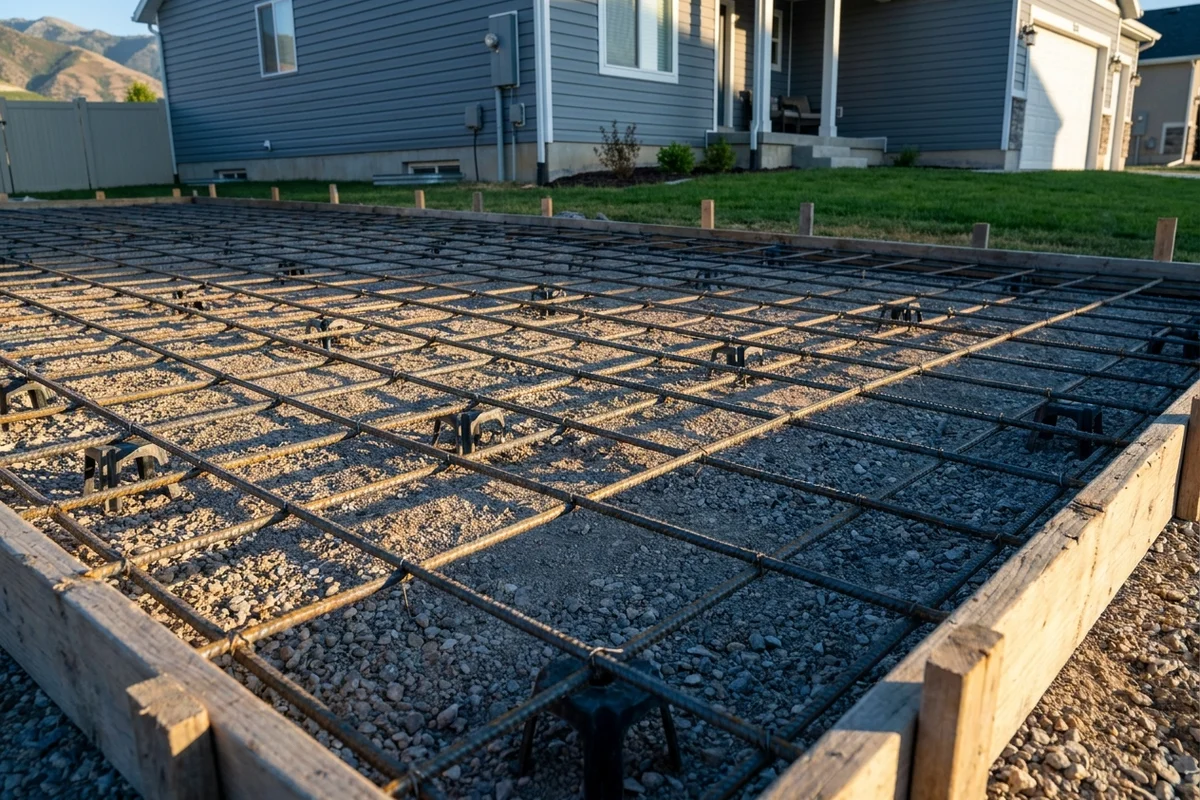
- #4 rebar grid on chairs, not wire mesh laid on grade
- Air-entrained 4,000+ psi mix so freeze-thaw cycles have somewhere to go
- Control joints saw-cut at 10–12 ft intervals, sized to the slab depth — joints are where you want the crack to form
- Subgrade prep: compacted road base, geotextile where soils warrant, positive drainage off the pad
- Curing compound applied within 30 minutes of finishing — no plastic-sheet shortcuts
That's the spec on every driveway we pour. It's also why we walk away from jobs where the customer wants us to skip the rebar to save $400.
Concrete vs. Asphalt vs. Pavers — Driveway-Specific
| Material | Lifespan (Utah) | Maintenance | Up-front Cost | Best Fit |
|---|---|---|---|---|
| Concrete (what we do) | 30–40 years | Re-seal every 2–3 years (optional) | Highest | Long-term homeowners, anyone tired of patching |
| Asphalt | 12–20 years | Re-seal every 3–5 years (required) | Lowest | Short-hold properties, very long rural drives |
| Pavers | 25–30+ years | Periodic re-leveling, weed control | Highest | High-design front yards, freeze-prone shaded areas |
Our Process
Free On-Site Estimate
A BaseScape designer comes to you. The visit takes 30–45 minutes and covers a site walk and measurement, drainage assessment, tear-out scope, rebar and thickness recommendation matched to your use case, and a joint pattern walked on-site so you know where the lines will fall. You receive a written, itemized quote within 24 hours — no deposit, no high-pressure pitch.
Permits, Tear-Out & Subgrade
We pull every required city permit for the approach. Existing concrete is demoed and hauled off (itemized in the quote — we don't subcontract demo). Subgrade is excavated to depth, compacted with a plate compactor or jumping jack, and gravel base is installed and re-compacted. Geotextile fabric goes down in expansive clay conditions.
Form, Rebar & Pour
Forms are set to grade with positive slope away from the foundation. #4 rebar grid is laid on chairs (not on grade) and tied. Air-entrained 4,000+ psi concrete is placed, screeded, floated, and finished — broom, exposed aggregate, or stamped to your spec. Control joints are sawcut at engineered spacing within 12 hours.
Cure, Seal & Walkthrough
Curing compound is applied immediately after finishing. We protect the slab from foot traffic for 24 hours and vehicle traffic for 7 days. A penetrating sealer is applied. Final walkthrough covers expected hairline cracking, sealing schedule, and your written workmanship warranty.
Your Questions, Answered
Structural Safety
Standard residential driveway: 4-inch slab on 4 inches of compacted road base, #4 rebar grid on chairs. RV pads, heavy vehicle parking, and steep approaches step up to 5–6″ slabs with engineered reinforcement. Every exterior pour uses 4,000+ psi air-entrained concrete (5–7% entrained air) — the air pockets give freezing water somewhere to go, which is the single most important defense against freeze-thaw failure.
Code Compliance
Any driveway approach connecting to a public street requires a city permit and inspection — slope, geometry, and right-of-way work all need approval. BaseScape pulls every required permit, schedules every inspection, and verifies your specific city's slope and approach geometry requirements before we form. You don't deal with the permit office.
Drainage & Moisture
Every driveway is poured with a minimum 1% slope (1/8″ per foot) away from your foundation. Drainage is engineered during site prep — we evaluate where water currently ponds vs. where it needs to go before we set forms. Where soil drainage is poor, we install a French drain or rock pit along the low edge of the pad.
Dust & Disruption
Demo of existing concrete is scheduled in a single day with same-day haul-off — driveway, sidewalk, and front yard all stay accessible. Saw-cutting control joints uses water-fed saws. Forms are set carefully to protect lawn, landscaping, and existing hardscape. Your front entry stays usable throughout the project except on pour day.
Cost & Affordability
Pricing depends on square footage, tear-out, slope, and finish. To set expectation:
- Single 2-car driveway (~600 sq ft, broom finish, rebar, no tear-out): $4,500–$6,500
- 2-car with apron (~750 sq ft, with tear-out and demo): $6,000–$8,500
- 3-car or side-approach driveway (~1,000+ sq ft): $8,500–$12,000+
- Stamped or decorative finish adds $4–$8 per sq ft over broom
Every quote is itemized — base, rebar, concrete, finish, sealer, demo — so you see exactly what each line costs.
Aesthetics
Choose from broom finish (most common — slip-resistant and inexpensive), exposed aggregate (decorative pebble surface), stamped concrete (slate, flagstone, brick, wood plank patterns), salt finish, or integrally colored and acid-stained options. We bring physical sample boards to the estimate visit so you can see and feel the finish before we pour.
Timeline
Typical residential driveway runs 2–3 working days on-site (demo day → form & rebar day → pour day). You stay off the slab 24 hours, off in a car 5–7 days, and parking anything heavy (RV, dumpster) waits 28 days. From signed estimate to finished walkthrough is typically 2–3 weeks during pour season.
What Sets Us Apart
Built for Utah's freeze-thaw — not in spite of it. Most cracked driveways on the Wasatch Front trace back to three contractor shortcuts: skipping air entrainment in the mix, under-spacing control joints, and finishing in conditions the concrete can't handle. We specify 4,000+ psi air-entrained mix on every pour, sawcut joints at engineered spacing within 12 hours, and won't pour when ground or air temperatures will cause problems with the cure. If concrete isn't the right answer for your driveway, we'll tell you — we install pavers too, and asphalt is rarely the right long-term call in Utah.
Still have questions? Drop your number and we'll call back within the hour — no pressure, just answers.
Frequently Asked Questions
How long does a driveway pour take?
Do I need a permit for a driveway in Utah?
Can you tear out and haul off my existing driveway?
When can you start? When does driveway pour season end?
Do you stamp or color concrete driveways?
What's your warranty?
How much does a concrete driveway cost in Utah?
Will my new concrete driveway crack?
What thickness should my driveway be?
Where do you pour driveways?
BaseScape is a new Utah contracting venture pouring our first season along the Wasatch Front. We're licensed (DOPL #14082066-5501 B100), insured, and building the company one finished project at a time. Verify our license on Utah DOPL .
Ready to discuss your concrete driveways project?